Get in your inbox the latest News and Offers from
- 297, av. Carmel; Goma City. North-Kivu/D.R of the Congo

- Office Time:
- Monday to Friday 7:30am - 6:00pm
- Call Us:
- +243819806801
- Email:
- info@hopesol.net
DRCongo Telecom Challenge: When Infrastructure Dictates Project Schedules in the DRC
DRCongo Telecom Challenge: When Infrastructure Dictates Project Schedules in the DRC
DRCongo Telecom Challenge: When Infrastructure Dictates Project Schedules in the DRC
The Logistical Challenge in Remote Environments:
Deploying technological or energy infrastructure in the Democratic Republic of Congo (DRC) is as much a feat of engineering as it is an extreme logistical challenge. While the design phase in urban areas follows standard project management protocols, transitioning to the execution phase in remote environments confronts teams with an unyielding reality: the lack of reliable road infrastructure. This logistical bottleneck does not merely delay deliveries; it triggers a domino effect that shakes the very foundations of the project?s triple constraint.
Transport Hell: From Asphalt to Dirt Tracks
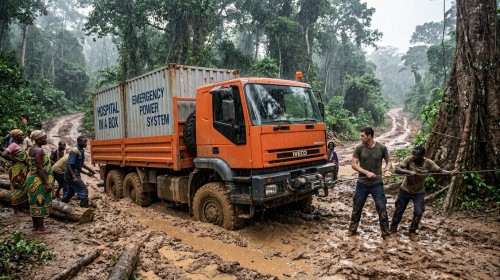
The journey of equipment?from urban centers or ports of entry to deep installation sites in the bush?often turns into a full-blown expedition. Paved roads quickly give way to sandy tracks, mud pits rendered completely impassable during the rainy season, or unpredictable waterways.
For field engineers, every kilometer becomes an unknown variable. Vehicles get bogged down, equipment endures extreme vibrations requiring heavy protective over-packaging or makeshift repairs, and cargo transfer points multiply. This chaotic transport is the first link in a chain of major disruptions.
From Logistical Delays to Scope Creep
In theory, the scope of work for an installation engineer is clearly defined: receive, assemble, and test the equipment. In the remote areas of the DRC, field realities force a constant redefinition of this boundary.
Faced with the unexpected, engineers must improvise and take on roles that were never part of the original project plan:
Clearing makeshift pathways or reinforcing artisanal bridges.
Securing equipment stored along the route for extended periods.
Managing unexpected community or local administrative challenges tied to transport blockages.
These unplanned, additional tasks are textbook examples of Scope Creep. The team's efforts are diverted from the primary objective to resolve peripheral logistical crises.
The Direct Impact on the Critical Path
In any engineering project, adhering to the Critical Path is what guarantees the final delivery date. Equipment transportation and site preparation tasks are typically the governing milestones of this path.
When road transport fails or takes twice as long as estimated, the entire critical path slips. Highly skilled engineers find themselves stranded on-site waiting for essential components, all while favorable weather windows close. This shift in critical tasks creates operational paralysis, where each day of delay on a telecom, solar, or hydroelectric installation indefinitely pushes back the commissioning date.
The Inevitable Consequence: Budget Explosion
This scope creep and critical path delay translate directly into a heavy financial blow. The initial budget, often calculated using optimistic theoretical baselines, is quickly overrun by major additional costs:
Labor overruns: Extended field mission allowances and overtime pay for technical teams immobilized on the ground.
Emergency logistics: Last-minute reliance on air freight or local hand-laborers to unblock stalled equipment.
Delay penalties: Contractual costs and penalties for failing to meet delivery deadlines agreed upon with clients or partners.
Conclusion
In the DRC, the success of a remote installation project does not rely solely on the technical expertise of the engineers, but on the resilience of the logistical model integrated from the very start of the planning phase. Recognizing the direct impact of transport constraints on Scope Creep and the Critical Path is essential. For project managers, this means building in realistic logistical contingency margins and flexible budgets?otherwise, ambitions for connectivity and development will continuously collide with the harsh reality of Congolese dirt tracks.